
Ultramarine Blue- FAQs
Ultramarine Blue is a synthetic inorganic pigment widely used for coloring plastics, masterbatch, paints, coatings, inks, textiles, cosmetics, and other applications. It is identified as Pigment Blue 29 (PB29) and C.I. 77007. The pigment belongs to the sodium alumino-sulphosilicate chemical family and is known for its bright blue shade, good lightfastness, and heat stability.
Pigment Blue 29 (PB29) is the Colour Index designation for Ultramarine Blue. It is an inorganic blue pigment used in applications including plastics, masterbatch, paints, coatings, inks, textiles, and other industrial products.
C.I. 77007 is the Colour Index number assigned to Ultramarine Blue, also known as Pigment Blue 29. Buyers and manufacturers may use PB29, CI 77007, or Ultramarine Blue when specifying this pigment.
The CAS number commonly associated with Ultramarine Blue / Pigment Blue 29 is 57455-37-5. SKU Pigments lists C.I. 77007 and CAS No. 57455-37-5 for its Ultramarine Blue products.
Yes. Ultramarine Blue is widely used in plastics because of its good heat stability, lightfastness, dispersion characteristics, and dimensional stability. It can be used across various polymer systems, including polyolefins and other thermoplastics, depending on the grade and processing conditions.
Yes. Ultramarine Blue is suitable for masterbatch applications and is used to achieve consistent blue coloration and blue undertones in plastic products. SKU Pigments describes its Ultramarine Blue as heat fast, light fast, and easy to disperse, with a typical particle size of approximately 1–2 microns (D50) for its masterbatch product.
SKU Pigments specifies a heat stability of approximately 340°C for its Ultramarine Blue pigment. Actual performance can vary depending on the polymer, processing time, formulation, stabilizer system, and pigment grade, so application-specific testing is recommended.
Standard Ultramarine Blue has poor acid resistance. Acid exposure can affect the pigment and may cause loss or change of blue shade. For applications such as PVC where acidic conditions may occur during processing, an acid-resistant Ultramarine Blue grade should be selected.
SKU Pigments lists Ultramarine Blue grades with a typical particle size in the range of approximately 1–2 microns, with some product specifications showing broader ranges depending on the application. Fine particle size helps support dispersion and uniform color development in plastics and masterbatch.
The recommended dosage depends on the polymer, desired shade, pigment strength, opacity or transparency requirement, processing method, and formulation. Therefore, there is no single dosage that is correct for every plastic application. SKU Pigments can recommend a suitable dosage based on the polymer, end-use application, and required shade strength. Laboratory trials are recommended before commercial production.
For PVC applications, the appropriate grade should be selected based on the processing conditions and the potential for acidic conditions during processing. Where acid sensitivity is a concern, an acid-resistant Ultramarine Blue grade is recommended to minimize shade loss or color change.
The main difference is the color undertone. Red Shade Ultramarine Blue produces a warmer, reddish-blue appearance, while a Green Shade grade produces a comparatively cooler, greener blue. The correct shade depends on the final color target and the polymer or application. PB29 is generally recognized for its relatively redder blue character compared with phthalocyanine blue.
Certain Ultramarine Blue grades are used for food-contact plastic applications, and SKU Pigments states that its Ultramarine Blue is approved for sensitive applications including food-contact plastics. However, food-contact compliance is grade- and regulation-specific. The appropriate regulatory documentation and compliance status should always be confirmed for the intended country, polymer, and end-use application before commercial production.
SKU Pigments currently lists packaging options of 5 kg, 10 kg, 25 kg, 50 kg, and 500 kg, depending on product and order requirements. Custom or application-specific packaging can be discussed with the sales team.
Yes. Samples are available from SKU Pigments. You can contact the team with your application details, required polymer or end use, desired shade, and approximate consumption so the appropriate Ultramarine Blue grade can be recommended.
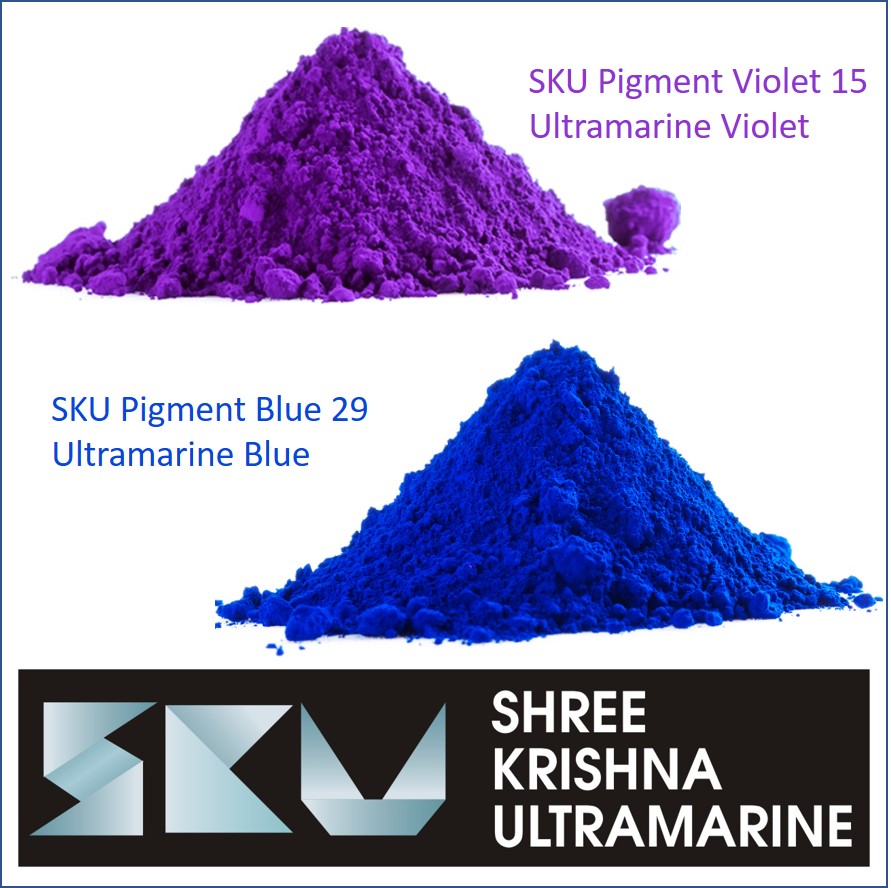
群青色颜料
群青色颜料的魅力与应用 群青色,这种源于青金石矿物的鲜艳蓝色色调,一直以来都深受各行各业的喜爱。其独特的特性使得它在众多行业中发挥了不可或缺的作用。那么,究竟是什么让群青色颜料如此特别?又有哪些应用值得我们关注?让我们一同探讨。 ## 群青色颜料的特点 群青色颜料除了其明亮的颜色外,还具有一系列优秀的性能: – **卓越的耐热性**:群青色颜料能够承受高温处理,适用于需要耐热的各种应用。 – **优秀的耐光性**:该颜料在暴露于光线时不会褪色,能够确保颜色长时间保持鲜艳。 – **稳定的不迁移性**:群青色颜料不会像某些其他颜料那样出现褪色或迁移,能够确保颜色准确无误地呈现在应有的位置。 ## 群青色颜料的应用 群青色颜料的应用范围广泛,涵盖了多个行业: **1. 塑料行业**:由于其卓越的耐热性和稳定的不迁移性,群青色颜料在塑料行业中被广泛应用,如食品包装,户外家具,儿童玩具等。 **2. 油漆和涂料**:群青色颜料的耐碱性、耐热性和耐光性,使其在装饰油漆、工业涂料和汽车涂料中都得以应用。 **3. 化妆品**:群青色颜料在各种化妆品中应用广泛,例如眼影、指甲油和沐浴产品,为用户带来色彩的饱满与活力。 **4. 橡胶行业**:在橡胶行业中,群青色颜料的耐热性和不迁移性使其被广泛应用在密封件、橡胶管和鞋类等产品中。 **5. …Read MoreRead More